Brown the beef. Pat the beef dry and season lightly with salt. Heat 1 tablespoon of the oil in a heavy pot over medium-high until shimmering, then brown the beef on all sides, 6–8 minutes total — work in two batches so it sears instead of steaming. Transfer to a plate.
Sweat the aromatics. Add the remaining oil and the onions to the pot and cook over medium heat for 8–10 minutes, until translucent with golden edges. Stir in the garlic and ginger and cook 1 minute, until fragrant.
Build the simmer. Add the carrots, potatoes, browned beef, and any accumulated juices, then pour in the stock, scraping up the browned bits from the bottom. Bring to a boil, then cover, lower the heat, and simmer gently for 20 minutes, until the carrots and potatoes are tender.
Melt in the roux. Drop the heat to low and add the curry roux blocks a few at a time, stirring until each batch fully dissolves before adding more — never dump them all in at once, or they clump.
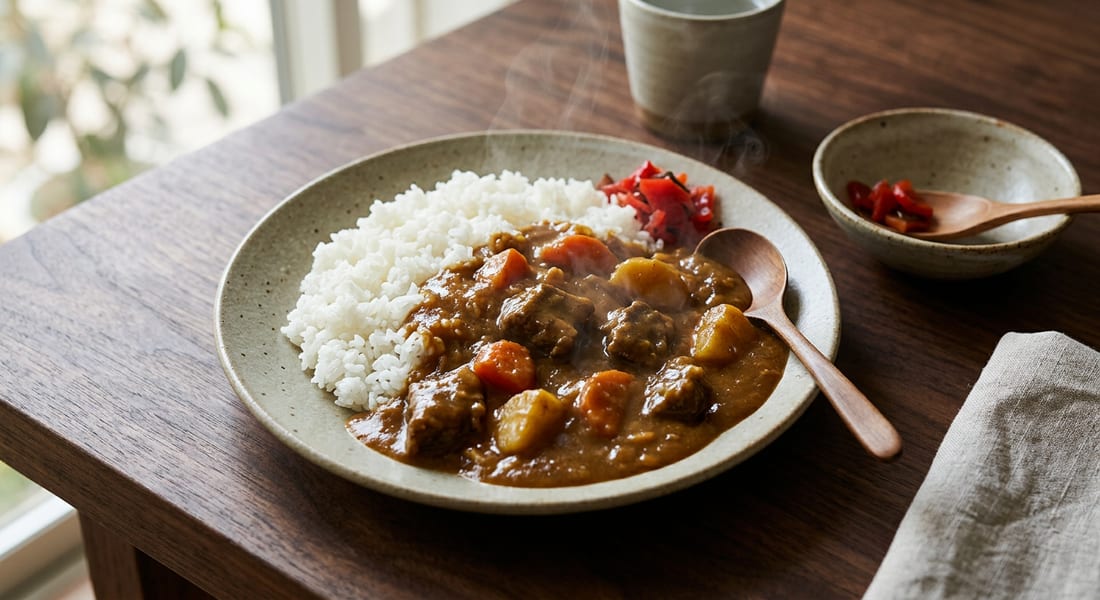
Thicken to a glossy gravy. Simmer uncovered on low for 10–15 minutes, stirring often from the bottom of the pot so the roux does not catch, until the curry is thick enough to coat the back of a spoon like warm gravy.
Season and balance. Stir in the soy sauce, honey, and grated apple. Taste: too thick means a splash more stock, too thin means 5 more minutes of uncovered simmering.
Serve. Spoon hot short-grain rice onto plates, ladle the curry over half of it, and finish with fukujinzuke or scallions. Leftovers deepen overnight — reheat gently with a splash of stock.
Can I make kare raisu without the curry roux block?
Yes. Make a DIY version: melt 4 tablespoons butter, stir in 5 tablespoons flour, and cook 2–3 minutes into a blond paste, then add 2 tablespoons curry powder, 1 teaspoon garam masala, and a pinch of cayenne. Whisk that paste into the simmering pot the same way you would the blocks, then round it out with 1 tablespoon each of ketchup and Worcestershire sauce — the standard block-roux flavor base. It is excellent, just slightly less silky than a commercial roux.
What cut of beef works best, and can I use something else?
Beef chuck is the classic — it is marbled enough to stay tender through the simmer and cheap enough for a family pot. Sirloin works if you want leaner and faster-cooking; slice it a bit thicker so it does not tighten up. Chicken thighs (cut large, simmer 15 minutes total) are the weeknight shortcut, and a fully vegetarian version with mushrooms, extra potatoes, and vegetable stock is a completely standard home variation in Japan.
Why did my curry turn out thin and watery instead of thick gravy?
Almost always a roux problem, not a simmer problem. Either not enough roux melted in (a standard box is sized for about 4 cups of liquid — extra stock means extra roux), or the roux was added at too high a heat and seized instead of dissolving, so the flour never hydrated. Fix a thin curry by melting an extra block or two in a ladle of hot broth off to the side, whisking smooth, then stirring it back in and simmering 5 minutes. Do not thicken with cornstarch — it gives a gloppy, translucent sauce instead of the matte, velvety gravy the roux builds.
Why is my kare raisu watery even after I added the roux?
Three usual causes. First, liquid ratio: a standard roux box thickens about 4 cups of liquid — extra stock, or waterlogged mushrooms and vegetables, demand extra roux. Second, heat: roux added to a rolling boil seizes into clumps that never release their starch, so the flour ends up suspended as lumps instead of dissolved as thickener; drop to low and add blocks gradually. Third, impatience: the gravy needs its final 10–15 minute uncovered simmer, stirring from the bottom, for the starch to swell and the sauce to turn glossy. If it is still thin, melt one or two extra blocks in a ladle of hot broth and stir that slurry back in.
My leftover curry turned into solid jelly overnight — what happened, and how do I fix it?
That is just the roux doing its job: the flour-and-fat base gels when cold, exactly like refrigerated gravy. Nothing is wrong. Reheat on low with a splash of stock or water, stirring from the bottom, and it loosens back into silky curry in a few minutes. Never reheat on high — sudden heat can split the emulsion and leave the fat swimming on top. If it loosens too far, simmer a couple of minutes to reduce; if it stays stiff, add stock a splash at a time until it moves like warm gravy again.
My curry tastes flat or slightly bitter — how do I rescue the pot?
Flat usually means under-seasoned relative to the roux: stir in 1 teaspoon soy sauce and 1/2 teaspoon honey, taste, and adjust again — the sweet-salty balance is what makes Japanese curry taste “right.” A few drops of Worcestershire or a small square of dark chocolate add the restaurant-style depth many curry shops use. Bitter almost always means scorched roux stuck to the pot bottom — do not stir the blackened bits back in; transfer the curry to a clean pot, leaving the burnt layer behind, and rebuild with a splash of stock. A grated half-apple stirred in at the end also softens any harsh spice edge.