Pound the cutlets: place each cutlet between two sheets of plastic wrap and pound with the flat side of a meat mallet or a rolling pin to an even 1/4 inch (6 mm) thick. Even thickness is everything — thin spots cook before the crust sets and thick spots stay raw in the middle. Season both sides with salt and pepper.
Set up the breading station: three shallow dishes — flour in the first, the beaten eggs with a pinch of salt in the second, and the breadcrumbs in the third. Dredge each cutlet in flour and shake off the excess, dip it into the egg until fully coated and let the excess drip off, then press it into the breadcrumbs so they cling evenly. Press lightly — you want a craggy, feathery coating, not a packed shell. Shake off loose crumbs and let the breaded cutlets rest 5–10 minutes on a wire rack so the coating sets.
Heat the fat: pour the oil or clarified butter into a large heavy skillet to a depth of about 1/2 inch and heat over medium-high to 350°F (175°C). A breadcrumb dropped in should sizzle immediately. The fat must be hot enough that the cutlets sizzle hard the moment they land, but it should never smoke.
Fry: lay one or two cutlets flat in the hot fat — do not crowd the pan — and fry 90 seconds to 2 minutes per side, until deep golden brown and craggy. The crust should bubble and ripple as it fries; that is the breading puffing away from the meat, which is exactly what you want. Flip once, with tongs.
Drain and keep warm: transfer the cutlets to a wire rack set over a baking sheet (not paper towels — trapped steam softens the crust) and season with a pinch of salt immediately. If you are frying more, hold finished cutlets in a 200°F (95°C) oven, uncovered, for up to 15 minutes, and let the oil come back to temperature between batches.
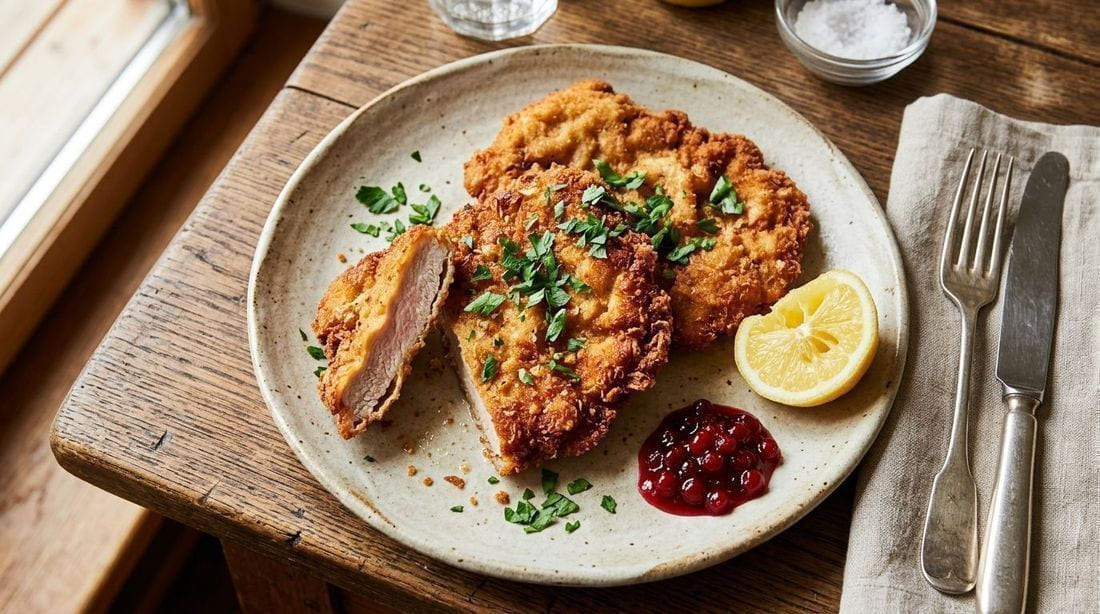
Serve within minutes of the last cutlet leaving the pan: lemon wedges, lingonberry jam, a scatter of parsley, and the salad on the side. A schnitzel waits for no one — that is the whole point of the dish.
Pork or veal — which is the traditional meat for wiener schnitzel?
True Wiener schnitzel is always veal — the name means "Viennese cutlet," and Austrian law protects it so strictly that a pork version must be sold as "Wiener Schnitzel vom Schwein." Veal gives the delicate, pale-gold classic. But pork loin chops are the beloved everyday version and the one most home kitchens actually make — slightly more forgiving, a touch more flavorful, and excellent value. Whichever you use, buy boneless cutlets from the loin and pound them thin; the technique matters far more than the animal.
Why does my schnitzel breading fall off in the pan?
Usually one of three things: the meat was not dry before dredging, the egg layer was too thick, or the crumbs were pressed on so hard the steam had nowhere to go. Pat the cutlets dry, give them a complete but light flour coat (it is the glue), let the excess egg drip off so you get a thin even layer, and press the crumbs on gently. Then rest the breaded cutlets 5–10 minutes on a rack before frying so the coating sets, and fry in fat at a true 350°F — cool oil soaks under the crust and lifts it right off.
Oil or butter for frying schnitzel?
The Viennese purist answer is clarified butter: rich, nutty, with a high smoke point that survives frying heat, and it is what gives the classic its golden, almost sweet crust. The practical home answer is a neutral oil like canola or sunflower — every bit as crisp, with the bonus that you can fry all four cutlets without the fat burning between batches. What to avoid is whole (regular) butter: the milk solids burn at frying temperature and turn the crumbs bitter.
Can I make wiener schnitzel gluten-free?
Yes, and it behaves better than most gluten-free swaps. Use fine gluten-free breadcrumbs (or blitz gluten-free crackers in a food processor), and add a teaspoon of cornstarch to the flour dredge so the coating grips the meat. The egg wash stays the same — it is what fuses the crumbs to the cutlet. Fry exactly as written: the gluten-free crumb browns a shade faster, so watch the second side and pull the cutlets at deep golden rather than mahogany. Serve with a gluten-free potato salad and check the lingonberry jam label for wheat starch, which a few brands add.
How do I reheat leftover schnitzel so it stays crispy?
The oven or the air fryer — never the microwave, which steams the crust into a leathery blanket. Reheat on a wire rack set over a baking sheet in a 375°F (190°C) oven for 8–10 minutes, flipping once, until the crust re-crackles when you tap it. In an air fryer, 375°F for 4–5 minutes does the same job faster. Leftovers keep in the fridge for 2 days, but the crust fades quickly, so treat them as a next-day lunch stopgap rather than a meal plan — schnitzel genuinely is a cook-and-eat-immediately dish.
Can I bake or air-fry schnitzel instead of pan-frying?
You can, with an honest trade-off. Air-fry at 400°F (200°C) for 8–10 minutes, flipping halfway, after spraying the breaded cutlets lightly with oil — the crust comes out crisp and golden, though without the deep, craggy texture and rich flavor of the pan. Baking at 425°F (220°C) on a wire rack over a sheet pan for 12–15 minutes works too, but the coating dries out more and the meat can overcook before the crumbs color. Both are fine weeknight shortcuts; neither is a true Wiener schnitzel. Save the full treatment for when the technique is the point.
 Cuisine