Poach and shred the chicken: place the chicken breasts in a saucepan with the stock and bay leaf — the chicken should be covered or nearly covered. Bring to a bare simmer over medium heat, then poach gently for 12–15 minutes, until the chicken reaches 165°F and offers no resistance when pierced. Lift it out, let it rest until cool enough to handle, then shred it into coarse threads with two forks or your fingers. Reserve the poaching stock.
Soak the bread: tear the bread slices into a blender jar and pour the evaporated milk over them. Let them soak 10 minutes until completely saturated — this humble slurry is the entire thickening engine of the sauce, so give it its time.
Build the sofrito: melt 3 tablespoons of the butter in a large skillet over medium heat. Add the onion and cook 8–10 minutes, until soft, sweet, and just beginning to catch color. Add the garlic and cumin and cook 1 minute more, until fragrant.
Bloom the ají amarillo: add the ají amarillo paste and the remaining tablespoon of butter to the skillet and cook for 2–3 minutes, stirring constantly, until the paste darkens slightly and the raw edge cooks off — the pan should smell fruity and warm, like a mild golden curry.
Blend the sauce: scrape the sofrito into the blender with the soaked bread and its milk. Blend on high for 1–2 minutes, until completely smooth — no specks of bread or onion should survive. Add the ground walnuts and parmesan and pulse once or twice just to incorporate.
Simmer: pour the sauce back into the skillet and set it over medium-low heat. Fold in the shredded chicken, then simmer gently for 10–12 minutes, stirring often, until the sauce thickens enough to coat a spoon and the chicken drinks in the golden color. Loosen with warm poaching stock or a splash more milk if it tightens beyond a thick velvet — aji de gallina should pour slowly, not sit like dough. Stir in the cream, season with salt, and taste.
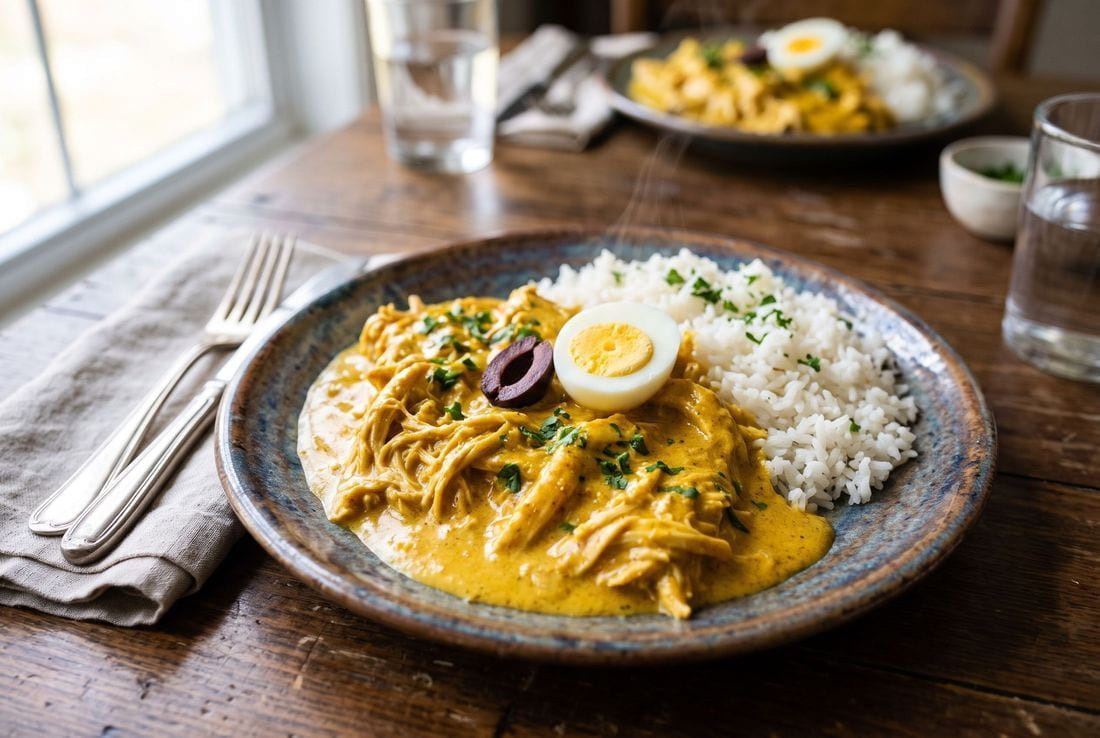
Serve: spoon the sauce generously over steamed white rice on each plate, lay a couple of boiled potato slices alongside so the sauce has a second place to land, and finish with a hard-boiled egg half and a black olive on top. Extra sauce on the side is never optional in a Lima kitchen.
Can I make aji de gallina with chicken thighs, rotisserie chicken, or leftover turkey?
Yes — and Peruvian cooks do all three. Boneless thighs are the most forgiving poached option (they stay juicy past 165°F), so if you prefer them, poach as directed. A store-bought rotisserie chicken is the classic weeknight shortcut: shred about 1 1/2 lb of meat and skip straight to the sofrito, using good chicken stock for the sauce instead of poaching liquid. Leftover turkey after the holidays makes an excellent aji de pavita — Peruvian kitchens do this every November, and nobody complains.
What is ají amarillo, and what can I substitute?
Ají amarillo is the yellow-orange Peruvian chile that anchors the country’s signature sauces — despite the name it ripens orange, with a fruity, almost raisin-like body and a medium glow of heat rather than a burn. Paste is the practical form for home cooks: sold jarred in Latin markets and online, it keeps for months in the fridge. The honest substitute is 1 yellow bell pepper blended with 1–2 teaspoons of hot yellow chile paste (or a single seeded habanero) — the bell supplies the color and body, the chile supplies the heat, and the dish stays recognizably itself.
Why rice AND potatoes with aji de gallina?
Because in Lima the sauce is the point, and it deserves two landing pads. The rice carries the bulk, the boiled potatoes soak up the second wave, and the hard-boiled egg and black olive finish the plate the way it arrives in every Peruvian picantería. Skipping one starch isn’t wrong, but the double-starch serve is the authentic habit — and it stretches the pot to feed six generously.
Why is my aji de gallina sauce thin and watery instead of silky?
The sauce has two engines: the bread-milk slurry and the reduction, and both need their time. Make sure the bread fully saturates before blending, and simmer the finished sauce long enough to evaporate the raw milk taste — it should coat a spoon and pour slowly, like warm velvet. If it is still thin at the end, simmer 3-4 minutes more; the parmesan and ground walnuts also thicken as they hydrate, so judge the final texture after a 2-minute rest. Cornstarch works in a pinch, but it dulls the silkiness the bread slurry gives you.
Can I make aji de gallina ahead, and why did my reheated sauce split or tighten?
Make it ahead — the flavor is better on day two. Refrigerate the chicken and sauce together for up to 3 days or freeze for 2 months. On reheating, the evaporated milk and cheese can tighten or look slightly grainy: warm it gently over low heat, never boiling, and whisk in a splash of milk, cream, or warm chicken stock until it loosens back to velvet. A brief blend with an immersion blender restores a perfectly smooth texture if it separated badly.
How spicy is aji de gallina, and can I make it milder or hotter?
Aji de gallina is a warm glow, not a burn — ají amarillo sits around 30,000-50,000 Scoville, but in a creamy, bread-thickened sauce it reads as fruity heat, comparable to a mild butter chicken. For a milder pot, cut the paste to 3 tablespoons; for hotter, add a second spoonful or a pinch of cayenne — do not swap in hotter chiles wholesale, because ají amarillo’s fruity flavor is the identity of the dish. Serve a little extra ají paste or rocoto sauce on the side for the heat-seekers at the table.