Simmer the chicken: put the chicken thighs in a large pot, add the onion halves and bay leaf, and pour in the broth plus enough water to cover by about an inch. Bring to a bare simmer over medium heat — never a rolling boil — skim the gray foam that rises, then simmer gently, half-covered, for 25 minutes until the chicken is cooked through and tender.
Shred and strain: lift the chicken out onto a plate and let it cool until you can handle it, then pull the meat from the bones in shreds, discarding skin and bones. Strain the broth through a fine sieve into a clean bowl — you want about 8 cups; top up with water if short — and return the clear broth to the pot.
Cook the rice in the broth: bring the strained broth back to a steady simmer, stir in the rinsed rice, and cook uncovered at a lively simmer for 15–18 minutes until the rice is fully tender and the broth looks slightly thickened — the rice releases its starch here, which gives the finished soup its body.
Whisk the egg-lemon base: while the rice cooks, whisk the cold eggs in a medium bowl for a full minute until uniformly frothy and pale — this is not optional, it is the emulsion. Still whisking, stream in the lemon juice. Set the bowl beside the pot with a ladle in it.
Temper the eggs: when the rice is tender, take the pot off the heat and let the boil die down for a minute. Ladle about a cup of hot broth in a thin stream into the egg-lemon bowl, whisking constantly and without stopping — the mixture should grow warm and foamy, never curdled. Repeat with a second and third ladleful until the bowl feels hot to the touch and has roughly tripled.
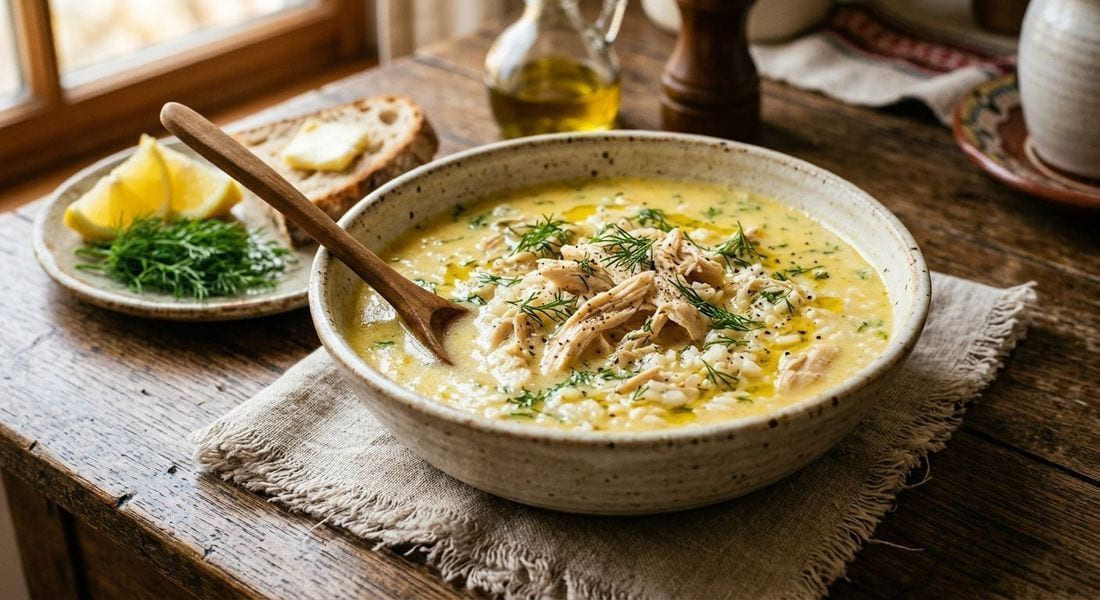
Marry the soup: whisk the tempered egg-lemon mixture back into the pot in a slow stream, stirring gently as it goes. Return the pot to the lowest heat — it should barely tremble, never bubble — and stir for 2–3 minutes as the broth thickens to a silky, pourable velvet. If it looks like it is about to boil, pull it off the heat; a boil will break the emulsion.
Finish and serve: stir the shredded chicken back in and let it warm through for 2 minutes over the lowest heat. Season with salt and pepper — taste, because broth saltiness varies — and stir in the dill. Ladle into warm bowls and serve immediately with lemon wedges and an extra grind of pepper.
What exactly is avgolemono?
Avgolemono (αβγολέμονο, from avgo "egg" + lemoni "lemon") is both a classic Greek sauce and, in this form, Greece’s most famous soup: chicken broth thickened and brightened with a tempered egg-and-lemon emulsion. The sauce version dresses dolmades, roast chicken, and greens; the soup version — broth, rice, and shredded chicken finished with the emulsion — is the one the word most often means outside Greece. The technique is old Greek village cooking: eggs were the thickener every household had, and lemon was the acid every household grew.
Can I make avgolemono ahead?
Partly. The broth, chicken, and rice base keeps beautifully for 3 days refrigerated — make it fully through step 3. But the egg-lemon emulsion is a live thing: it is at its silkiest in the first 20 minutes and grows denser and looser in the fridge. The professional move is to store the base and temper a small fresh emulsion at serving time (2 eggs + 2 tablespoons lemon juice per 4 cups of reheated base). If you must reheat the finished soup, do it gently over low heat with a splash of water, never at a boil.
Why is my avgolemono thin or watery?
Three usual suspects: not enough rice (it is the starch backbone — keep the full 3/4 cup and let it cook until truly tender), tempering too fast (the emulsion never forms, so nothing thickens — ladle slowly and whisk the whole time), or skipping the 2–3 minute gentle stir after combining, which is when the thickening actually happens. If it is still loose at serving, whisk one extra egg with a tablespoon of lemon juice, temper it with a ladle of the hot soup, and stir it back in off the heat.
How do I keep the eggs from scrambling in avgolemono?
Three rules, and the soup follows them without fail. First, temperature gap: eggs straight from the fridge, broth off the boil — the bigger the gap between them, the safer the temper. Second, dilution before reunion: whisk at least three ladlefuls of hot broth into the egg-lemon bowl before anything goes back in the pot, so the eggs arrive at the pot already warmed to nearly broth temperature. Third, no boiling after: once the emulsion is in, keep the pot at a bare tremble on the lowest heat, because the moment it bubbles the proteins seize and the soup turns grainy. Whisk the eggs frothy before the lemon goes in, too — a foamy base emulsifies; a flat one just curdles.
Can I use orzo instead of rice?
Yes — orzo is the Greek restaurant version and arguably the more traditional one; many tavernas would not recognize the rice. Swap the 3/4 cup rice for 1 cup orzo and cook it in the broth exactly the same way, about 9–10 minutes until al dente (orzo drinks broth faster than rice, so have an extra cup of hot broth or water nearby to loosen the pot). Everything else — the egg-lemon temper, the shredded chicken, the dill — stays identical. Orzo gives a softer, more pillowy bowl; rice stays distinct and gives the soup more body from its starch. Choose rice for gluten-free tables, orzo for texture.
Can avgolemono be frozen?
Not the finished soup — the egg-lemon emulsion is a live emulsion, and freezing breaks it into a grainy, separated puddle no amount of gentle reheating will fully repair. Freeze the base instead: the broth, chicken, and rice (step 3) freezes well for 2 months; thaw overnight in the fridge, reheat gently, and temper a small fresh egg-lemon emulsion at serving time — 2 eggs whisked with 2 tablespoons lemon juice, tempered with 2–3 ladlefuls of the hot base per 4 cups of soup. That five-minute finish gives you a genuinely fresh-tasting bowl, which is more than most frozen soups can say.