A green tea that crossed three continents
Sometime in the 1850s, a crate of green tea landed in Tangier, and Moroccan hospitality has never been the same. The tea itself was Chinese — a gunpowder green, rolled into tiny pearl-like pellets — but the route was British. When the Crimean War cut off the Baltic trade routes in 1853, British merchants, locked out of their usual Russian market, went looking for new customers. Morocco, a short sail from Gibraltar, was an obvious stop.
At first the tea was a luxury, sipped in the royal court and the grand houses of Fez and Marrakech. But the Moroccans did something unexpected: they made it their own. By the turn of the 20th century, tea had moved out of the palaces and into every home, market stall, and roadside stop in the country. Gunpowder green tea, fresh mint, and sugar had become a national institution.
Why mint? Why so much sugar?
The recipe is deliberate. Moroccan tea pairs a strong, slightly bitter green tea with handfuls of fresh spearmint — naanaa — and a generous lump of sugar. Mint grows everywhere in Morocco, even in the driest gardens, which made it the obvious local partner. The sugar balances the tea’s bitterness, and the whole thing is brewed hard and short: a few minutes over high heat, poured from a height, and served in small, decorated glasses.
That trio — gunpowder tea, mint, sugar — is also deeply practical. For much of the country’s history, water was boiled before drinking, and tea made boiled water taste like welcome. Hospitality and health, in one glass.
The ritual of the pour
Pouring is the performance. The teapot is lifted high above the glass, and the tea falls in a thin, foaming ribbon. The height aerates the tea, and the foam at the top of the glass — a sign of a proper pour — is a point of pride. The first glass is served after a short steep: strong and slightly bitter. The second, after the tea has rested, is gentler. By the third glass, the tea is lighter and sweeter. Guests are always offered three.
Refusing the first glass is, politely, impossible. Atay is served when guests arrive, before and after meals, during negotiations, and in the middle of any argument worth having. To pour tea for someone is to say: you are welcome here, and you are not in a hurry.
Making it at home
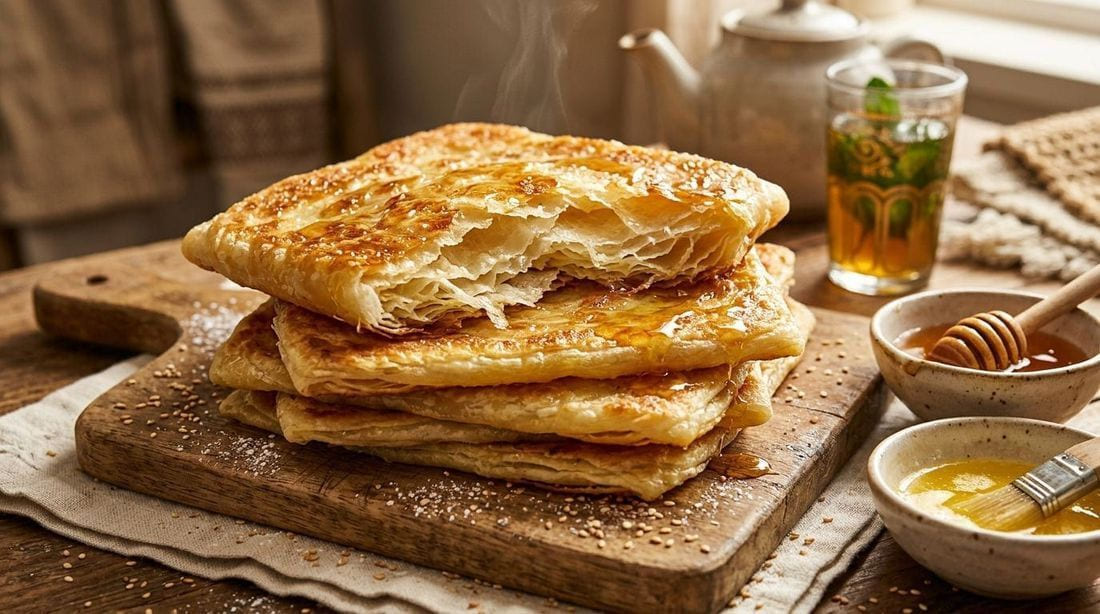
You do not need a Moroccan teapot to make proper atay. Use any small pot: rinse a spoonful of gunpowder green tea with a splash of boiling water and pour it off, add fresh water and a big handful of mint, sweeten to taste, and boil for three to five minutes. Pour from as high as you dare. Drink it with msemen (Moroccan layered flatbreads), amlou (almond-honey spread), or sellou (the toasted sesame treat) — the classic Moroccan tea-table spread.
One glass is never the point. Three is the point.