Make the marinade: in a large bowl, whisk the olive oil, lemon juice, lemon zest, crushed garlic, oregano, paprika, salt, pepper, and honey until emulsified and fragrant.
Marinate: add the chicken cubes and toss until every piece is coated. Cover and refrigerate for at least 4 hours, ideally 6–8 — the lemon and oregano need time to season the meat all the way through. Do not exceed 24 hours; the acid will start to tighten the texture.
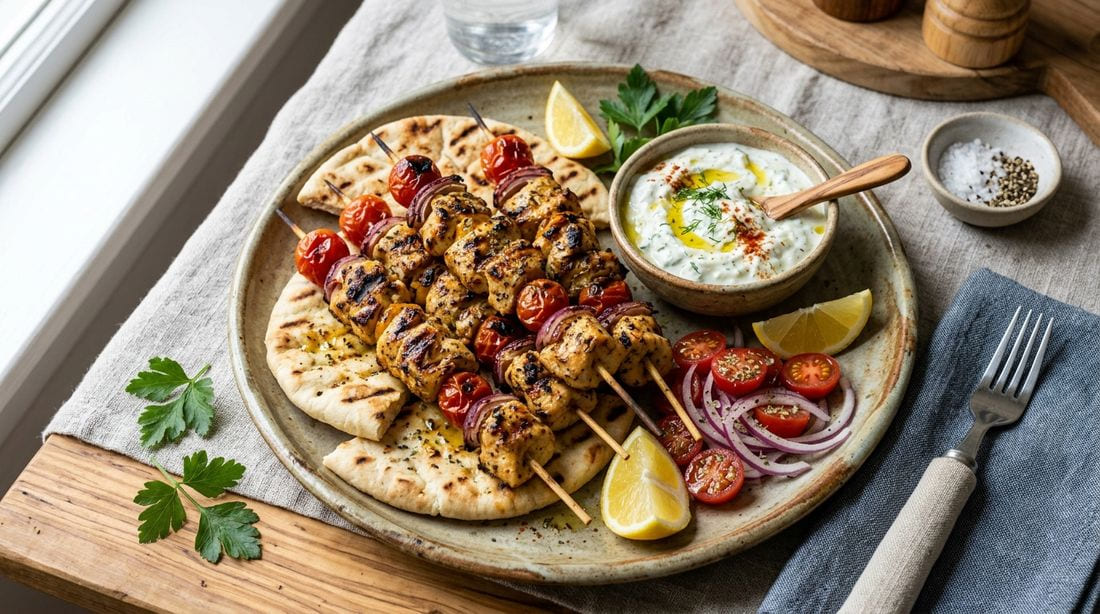
Thread the skewers: when ready to cook, thread 5–6 cubes onto each skewer, pressed snugly together but not jammed — touching edges keep the interior juicy, while a little breathing room lets the heat char the sides. Pat the surface of each cube lightly with a paper towel so it browns instead of steaming.
Grill: heat a grill pan, charcoal grate, or cast-iron skillet until it is properly hot (a drop of water should skitter). Cook the skewers 10–12 minutes total, turning every 3 minutes or so, until the outside is golden and lightly charred in patches and the thickest piece reads 165°F (74°C) inside.
Rest briefly: transfer the skewers to a platter and let them rest 3–4 minutes so the juices settle back into the meat.
Serve: scatter with chopped parsley and a pinch of flaky salt, and bring warm pita, tzatziki, red onion, tomato, and lemon wedges to the table — build-it-yourself is the whole point.
How long should I really marinate the souvlaki?
Four hours is the floor where the lemon and oregano reach the middle of each cube; 6–8 hours is the sweet spot for street-stand depth; overnight is fine and arguably best. Past 24 hours, though, the lemon acid starts to denature the surface proteins into a mushy, cured texture — so marinate overnight, but never for two nights. No time at all? Even 30 minutes with the zest doubled gives a decent weeknight version.
My chicken came out dry — what went wrong?
Nine times out of ten it is one of two things: breast meat instead of thighs, or a pan that was not hot enough, so the cubes lingered and cooked through before the color arrived. Thighs, a properly preheated surface, and turning every 3 minutes keep the cook short. Also check the cube size: 1 1/4-inch (3 cm) is the target — smaller cubes overcook in the time it takes to char, larger ones char outside before the middle is done. And pat the marinated surface dry before it hits the heat; wet meat steams instead of searing.
Can I make souvlaki without a grill — oven or stovetop?
Yes. Stovetop: a cast-iron grill pan or heavy skillet over medium-high heat, 10–12 minutes turning as above, works nearly identically. Oven: thread onto skewers, rest them across a rimmed baking sheet so they hang over the surface, and broil on the top rack for 10–12 minutes, turning once, until golden and charred at the edges. Air fryer works too: 375°F (190°C) for 12–14 minutes, shaking or turning halfway. The char patches are the signature, so use the highest, most direct heat you have.
How long should I really marinate the souvlaki?
Four hours is the floor where the lemon and oregano reach the middle of each cube; 6–8 hours is the sweet spot for street-stand depth; overnight is fine and arguably best. Past 24 hours, though, the lemon acid starts to denature the surface proteins into a mushy, cured texture — so marinate overnight, but never for two nights. No time at all? Even 30 minutes with the zest doubled gives a decent weeknight version.
My chicken came out dry — what went wrong?
Nine times out of ten it is one of two things: breast meat instead of thighs, or a pan that was not hot enough, so the cubes lingered and cooked through before the color arrived. Thighs, a properly preheated surface, and turning every 3 minutes keep the cook short. Also check the cube size: 1 1/4-inch (3 cm) is the target — smaller cubes overcook in the time it takes to char, larger ones char outside before the middle is done. And pat the marinated surface dry before it hits the heat; wet meat steams instead of searing.
Can I make souvlaki without a grill — oven or stovetop?
Yes. Stovetop: a cast-iron grill pan or heavy skillet over medium-high heat, 10–12 minutes turning as above, works nearly identically. Oven: thread onto skewers, rest them across a rimmed baking sheet so they hang over the surface, and broil on the top rack for 10–12 minutes, turning once, until golden and charred at the edges. Air fryer works too: 375°F (190°C) for 12–14 minutes, shaking or turning halfway. The char patches are the signature, so use the highest, most direct heat you have.
 Cuisine