Build the porcini stock: put the dried porcini in a bowl and cover with 2 cups of the just-boiling-hot stock; soak 20 minutes. Lift the porcini out, squeeze them over the bowl, chop them coarsely, and set aside. Strain the soaking liquid through a paper towel or fine sieve to catch grit, and pour it into the pot of remaining stock — keep the whole thing at a bare simmer on a back burner for the entire cook.
Sauté the mushrooms: heat 1 tablespoon of the butter and the olive oil in a wide, heavy pan over medium-high heat until the butter stops foaming. Add the cremini in one layer and leave them undisturbed 3–4 minutes until deeply golden, season with salt and pepper, stir once, and cook 2 minutes more. Reserve a third for topping; leave the rest in the pan and drop the heat to medium.
Soffritto and tostatura: add the remaining tablespoon of butter and the finely diced onion to the pan with a pinch of salt; cook 4–5 minutes until soft and translucent but not colored. Stir in the garlic and chopped porcini for 1 minute, then add the rice and toast it, stirring, for 2 minutes until the edges look glassy and translucent — the grains should smell faintly nutty.
Wine, then stock ladle by ladle: pour in the white wine and stir until it has fully evaporated, 1–2 minutes. Then start the ritual: add a ladleful of hot porcini stock and stir with a wooden spoon until the liquid is nearly gone — the rice should never drown, never dry out. Keep adding ladles, one at a time, stirring often but not frantically, for 16–20 minutes.
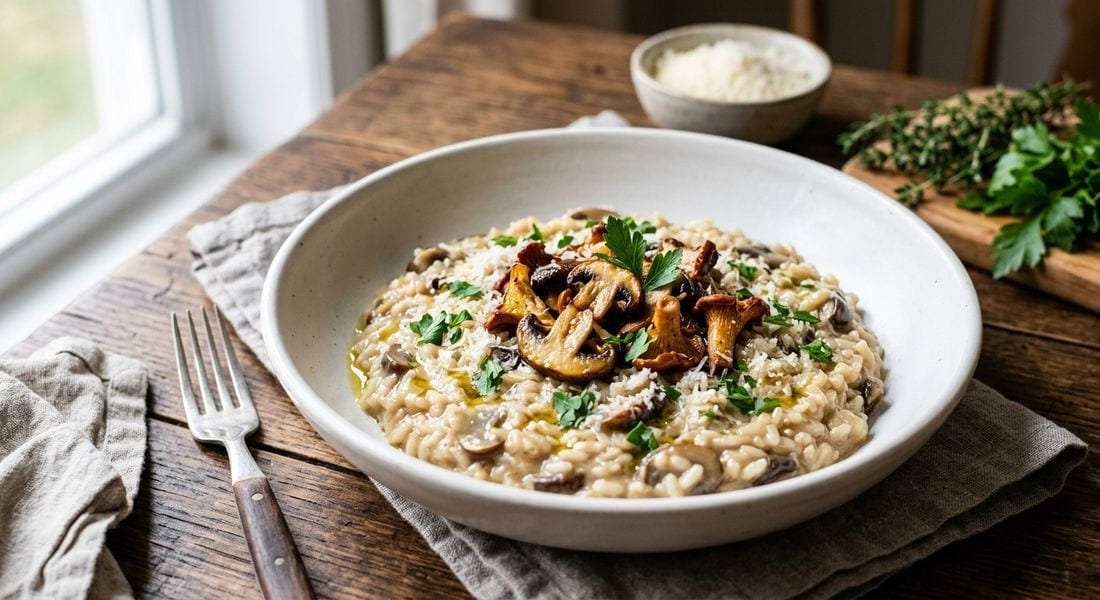
Stop at al dente: start tasting from minute 15 — the rice is done when the grain is tender outside with a faint pearly center when you bite, and the whole pan flows slowly when you tilt it. It should be all'onda — wavy, not soupy, not stiff. You may not need every cup of stock; judge by texture, not the quantity list.
Mantecatura: pull the pan off the heat. Beat in the cold butter and the grated Parmesan vigorously for 30 seconds — the risotto should turn glossy and ripple like lava. Stir in the parsley, taste, and adjust salt and pepper. Lid on, 2 minutes off the heat, then spoon into warm shallow bowls, top with the reserved mushrooms and a final dusting of Parmesan. Serve immediately — risotto waits for no one.
Why is my risotto rice still hard in the middle after 25 minutes?
Three usual causes: stock added too slowly or too cold, heat too low, or rice that was never toasted. Risotto cooks at a lively simmer — if the pan is barely bubbling, the starch will not release and the center stays chalky. Keep the heat at medium so each ladle bubbles steadily, keep every ladle of stock hot, and confirm the tostatura: the rice should look glassy at the edges before the first liquid goes in. If it is still chalky near the end, add two hot ladles, stir briskly, and give it 5 more minutes.
Why did my risotto turn out gluey instead of creamy?
Gluey risotto is broken or over-stirred rice, not under-stirred rice. The usual culprit is cooking past al dente — Arborio needs that faint pearly bite at the center; a few minutes more and the grains burst into paste. Over-stirring, especially with a whisk or against the bottom of the pot with force, also strips the grains. Stir regularly but gently with a wooden spoon, stop at the bite test, and remember the mantecatura does the final smoothing — butter and Parmesan beaten in off the heat turn glossy, not gluey.
Does the stock really need to stay hot the whole time?
Yes — it is the one step that most changes the outcome. Every ladle of cold stock drops the pan temperature, the rice stops releasing starch, and you get a longer, uneven cook with a chalky texture. Keep the stock at a bare simmer on a back burner for the entire 20 minutes, and ladle from it straight to the pan. If you are using a stockpot on a second burner, you can even ladle from pot to pan without a break in the rhythm.
Why is my risotto rice still hard in the middle after 25 minutes?
Three usual causes: stock added too slowly or too cold, heat too low, or rice that was never toasted. Risotto cooks at a lively simmer — if the pan is barely bubbling, the starch will not release and the center stays chalky. Keep the heat at medium so each ladle bubbles steadily, keep every ladle of stock hot, and confirm the tostatura: the rice should look glassy at the edges before the first liquid goes in. If it is still chalky near the end, add two hot ladles, stir briskly, and give it 5 more minutes.
Why did my risotto turn out gluey instead of creamy?
Gluey risotto is broken or over-stirred rice, not under-stirred rice. The usual culprit is cooking past al dente — Arborio needs that faint pearly bite at the center; a few minutes more and the grains burst into paste. Over-stirring, especially with a whisk or against the bottom of the pot with force, also strips the grains. Stir regularly but gently with a wooden spoon, stop at the bite test, and remember the mantecatura does the final smoothing — butter and Parmesan beaten in off the heat turn glossy, not gluey.
Does the stock really need to stay hot the whole time?
Yes — it is the one step that most changes the outcome. Every ladle of cold stock drops the pan temperature, the rice stops releasing starch, and you get a longer, uneven cook with a chalky texture. Keep the stock at a bare simmer on a back burner for the entire 20 minutes, and ladle from it straight to the pan. If you are using a stockpot on a second burner, you can even ladle from pot to pan without a break in the rhythm.
 Cuisine