Toast the almonds: spread them on a baking sheet and roast at 350°F for 8–10 minutes, shaking once, until golden and fragrant and they smell nutty. Let them cool completely on the sheet.
Transfer the cooled almonds to a food processor and process for 3–4 minutes, scraping down the sides, until they turn into a smooth, runny almond butter (it will go thick and pasty before it loosens — keep going).
Add the honey, argan oil, and salt. Process again for 1–2 minutes, scraping down, until the spread is glossy and fully smooth. Taste and add a little more honey or salt to your liking.
Spoon the amlou into a clean jar or bowl. It will thicken slightly as it rests at room temperature.
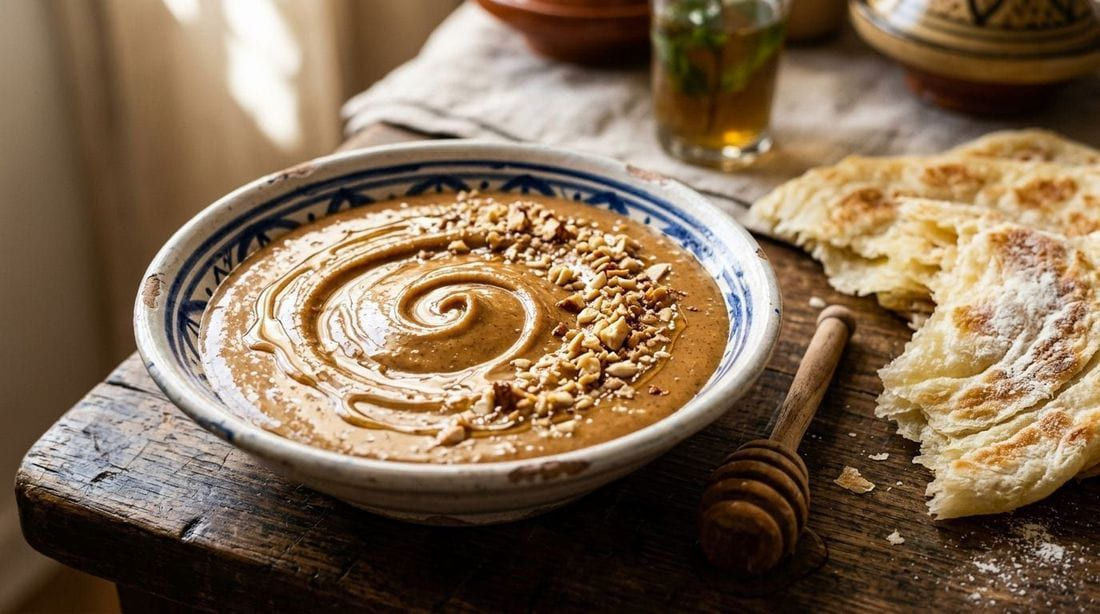
Serve generously over warm Msemen, crepes, pancakes, toast, or good bread, and store the rest in an airtight jar.
What does amlou taste like?
Amlou tastes like toasted almonds, warm honey, and a whisper of toasty, buttery argan oil — sweet, nutty, and silky with a subtle earthy richness. It is similar to a high-quality almond or hazelnut spread, but the argan oil and honey give it a distinctive Moroccan warmth.
What is argan oil, and can I substitute it?
Argan oil is a prized cold-pressed oil from the kernels of the Moroccan argan tree, with a toasty, nutty flavor and a high content of vitamin E. True food-grade (not cosmetic) argan oil is key for authenticity. If you do not have it, a mild nut oil like hazelnut or macadamia, or a light olive oil, works well — the amlou will be slightly less distinct but still delicious.
How should I store amlou, and how long does it keep?
Store it in an airtight jar at room temperature, out of direct sunlight, for up to 3–4 weeks. The honey and oil act as natural preservatives. It may separate slightly as it sits — just stir it before use. No refrigeration needed, though a cool pantry keeps it freshest.
What do Moroccans eat amlou with?
It is a breakfast staple: spread thickly over Msemen (Moroccan layered flatbreads), crepes, pancakes, or chewy artisan bread, ideally with a pot of mint tea. It is also spooned over fresh fruit and used as a filling for pastries. There is no wrong way to eat a nut-honey spread this good.
Why did my amlou turn out gritty?
The almonds were not ground long enough, or crystallized honey was used. Run the food processor the full 3–4 minutes until the almonds become a truly smooth butter before adding the honey — the paste phase can feel like failure but is normal. If your honey is crystallized, warm it gently in a water bath until runny before mixing.
Why did my amlou separate or turn oily?
Separation happens when the almonds are over-processed (too much oil released) or when the oil-to-honey ratio is off. Stir it well before each use — a little separation is normal for a natural nut spread. To prevent it, stop processing as soon as the spread is glossy, and if it is very oily, blend in a spoonful more honey to re-emulsify.
Can I make amlou without argan oil?
Yes. Use a mild, high-quality nut oil — hazelnut or macadamia are closest in richness — or a light olive oil. The amlou will be slightly less nutty and less distinct, but still silky and delicious. Skip the extra oil entirely and add a tablespoon of water if you want a thicker, oil-free version.
Affiliate disclosure: this page contains affiliate links. If you buy equipment through them, Cuisinety earns a small commission at no extra cost to you — it keeps the site free, and we only recommend gear we actually use. Read ourfull affiliate disclosure.