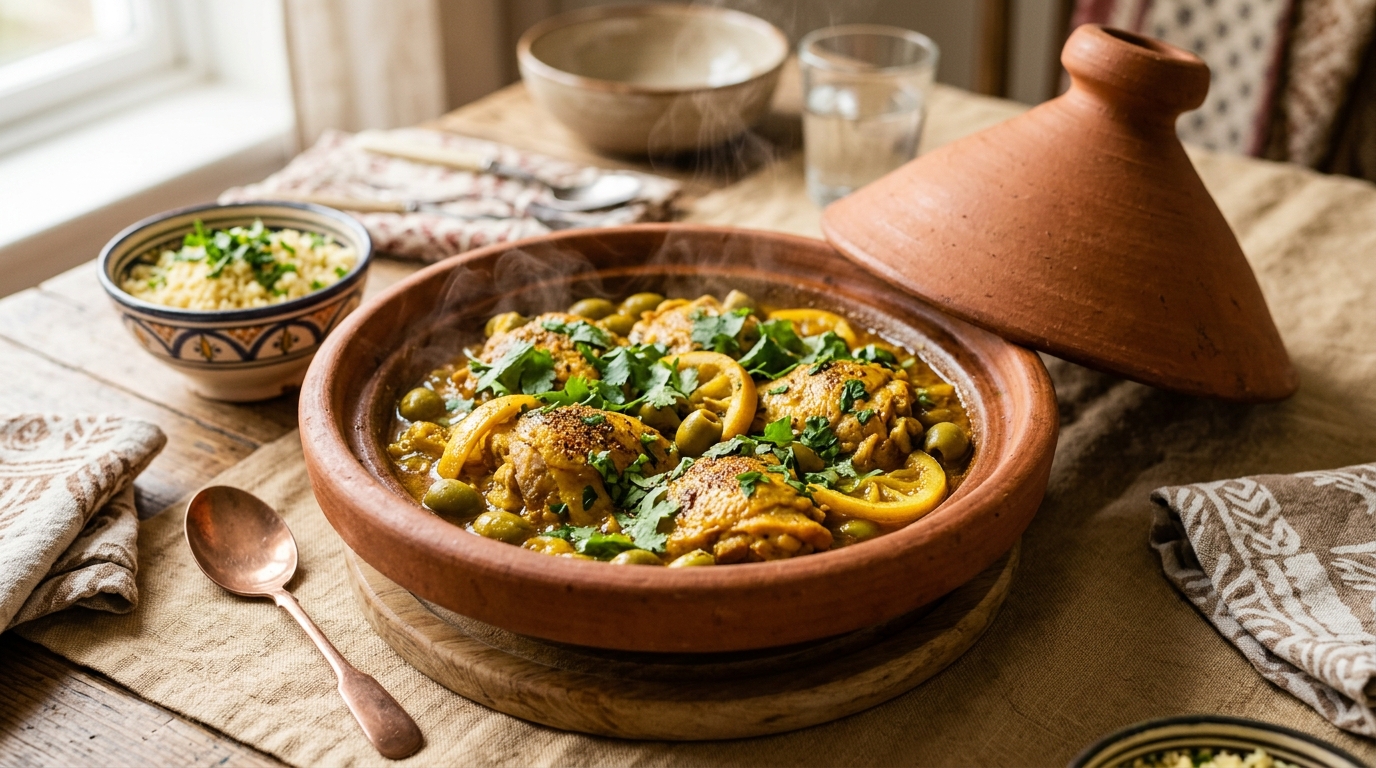
Forget the pot (for a second)
Everyone asks the same question: do I need an actual tagine? The honest answer is no. The clay pot with the conical lid is beautiful and it does have a job — but the job is technique, not magic. A heavy Dutch oven with a tight lid produces the same result. The real tagine technique lives in three habits: a bed of onions, heat so low it barely whispers, and a lid that stays shut.
That said, the clay pot is not a gimmick. The cone of the lid traps steam, lets it cool, and drips it back down over the food in a continuous, gentle self-basting loop. A Dutch oven does the same thing, just without the pretty hat. Use whichever you own.
The onion bed is the sauce
Moroccan tagines do not start with oil and browning. They start with onions — thinly sliced and spread across the bottom of the pot in an even layer. This is the most important move in the entire dish. As the pot heats, the onions release juice and slowly collapse into a jammy, golden sauce. They cushion the meat, keep it from sticking, and sweeten the whole dish without a spoonful of sugar.
No stock, no water bath, no liquid beyond a splash. The onions, the meat, and the lid do all the work. In a proper tagine, the sauce is not added — it is created.
Low heat. Lid on. Do not peek.
A tagine is not a sear. It is a long, gentle braise. Moroccans say a tagine should cook on a heat so low you can hold your hand over the pot — the faintest simmer. On a stovetop, that means the smallest burner at its lowest setting, and a diffuser if your stove runs hot.
The lid stays on. Every time you lift it, you let out the exact steam that was about to condense and drip back down. The classic advice holds: do not lift the lid for the first 45 minutes. Trust the steam — it is the only liquid you will never have to add.
The finishing act
When the meat is tender enough to fall apart — usually after 60 to 90 minutes — the tagine enters its second act. Off comes the lid, and the heat goes up just a little. The sauce bubbles down and tightens, concentrating the onion juices into something almost syrupy. This is also the moment for the briny finishing ingredients: preserved lemon and olives. They go in late, so they stay bright instead of turning flat and salty.
Then the hardest step: rest. Ten minutes off the heat lets the sauce settle back into the meat. Serve from the pot, with bread or couscous for scooping, and pour a glass of mint tea. You have earned it.
Three mistakes that dry out a tagine
Death by lid-lifting. Every peek releases the steam that would have become sauce. Open the pot zero times in the first 45 minutes. Death by heat. A tagine that bubbles like pasta water will dry out before it tenderizes — it should shiver, not boil. Death by stirring. Stop it. The onions need stillness to melt, and the meat needs stillness to hold its shape. Trust the layers.
Get those three right, and you can cook a tagine in a ten-dollar pot with five ingredients. Start with our 5-Ingredient Moroccan Tagine, then graduate to chicken with preserved lemon or lamb with prunes.