Journal · Technique · By Yasmine
Spice Storage and Shelf Life: What Lasts, What Doesn't, and How to Tell
How long spices actually last, whole vs ground, how to toast and test freshness, and the storage setup that keeps every jar worth using.
 cuisinety
Journal · Technique · By Yasmine
How long spices actually last, whole vs ground, how to toast and test freshness, and the storage setup that keeps every jar worth using.
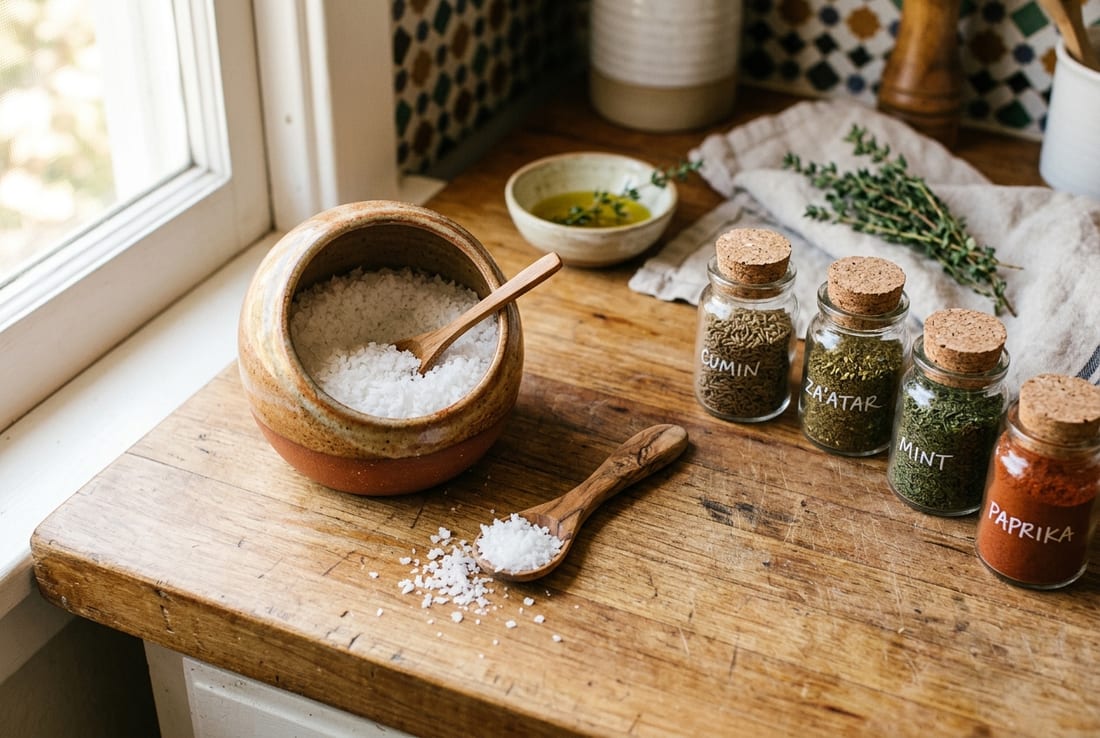
Spices don't spoil in the dangerous sense — old paprika won't hurt you. They fail in the quieter, more expensive way: they stop doing their job. The character of a spice lives in its volatile oils, and those oils oxidize the moment the spice is ground and exposed to air, light, and heat. A jar of cinnamon from three years ago isn't delivering cinnamon flavor so much as the memory of it, and no amount of extra scooping brings the aroma back.
This matters more than most home cooks think, because stale spices don't just taste like nothing — they make whole recipes feel flat. A tagine with fresh cumin sings; the same tagine with dead cumin needs constant salt-adjusting and still lands dull. In baking the gap is even sharper, because there's no sauce or braise to hide behind: a stale anise note in chebakia syrup or a faded cinnamon in kaab el ghazal is just gone.
The good news is that spice freshness is one of the cheapest upgrades in the kitchen. Nothing in this guide requires new equipment or a big spend — mostly it's about buying less at a time, storing it better, and spending thirty seconds checking whether a jar is still alive.
The single biggest freshness decision is whole vs ground, and the physics are simple: a whole peppercorn or cinnamon stick exposes only its surface to air, while ground spice exposes everything. That's why the standard guidance — which holds up in practice — gives whole spices roughly 2 to 4 years of good character, ground spices 6 to 12 months, and dried leafy herbs somewhere between, at 1 to 3 years. Seeds like cumin and coriander sit at the durable end; anything ground fine and papery (paprika, ground ginger) fades fastest of all.
The practical strategy follows directly: buy whole wherever your kitchen can handle it. Whole cumin, coriander, peppercorns, and cinnamon sticks can be ground in a dedicated cheap blade grinder in seconds, and each jar keeps its punch for years instead of months. Reserve pre-ground buying for the things you genuinely can't grind at home — turmeric root, paprika, ground ginger — and buy those in the smallest container you can find.
One honest tradeoff: grinding takes thirty seconds and one more dish to wash. If that friction means you won't do it, well-turned-over pre-ground spices from a busy shop beat whole spices that sit unused. The best setup is the one you'll actually use.
Rather than a spreadsheet, here's the shorthand version worth memorizing. Whole spices and seeds (peppercorns, cumin seed, coriander seed, cinnamon sticks, whole nutmeg, cloves): 2 to 4 years, and nutmeg and cloves arguably longer. Ground spices: 6 to 12 months for the delicate ones (paprika, ground ginger, ground turmeric, ras el hanout and other blends), up to around 2 years for sturdy ones like ground cumin. Dried leafy herbs (thyme, oregano, mint, bay): 1 to 3 years. Blends are their own category — they're ground already, so treat every blend as 6 to 12 months no matter what the jar promises.
Two things shorten those numbers dramatically, and both are common in real kitchens. Heat: a spice rack mounted above the stove can age ground spices two or three times faster than a closed drawer, because every time you cook, the jars take a warm bath. Light: spices in glass jars on a sunny windowsill fade fast, whatever the label says. Heat and light, not air alone, are what you should fix first.
Write the month you opened each jar on the label with a marker — not the expiry date printed by the factory, which assumes ideal storage. Six months later you'll know exactly which jars are veterans, and rotating in fresh stock becomes a two-minute job instead of a mystery.
Toasting is the closest thing to a free upgrade in cooking. Whole spices toasted dry in a pan for a minute or two — just until fragrant, then immediately out of the hot pan — wake up oils that grinding alone won't reach. The same cumin seeds that smelled pleasant raw become deep and nutty after a toast, and the difference lands straight in the finished dish. The rules: dry pan, medium-low heat, constant motion, and pull them the moment you can smell them — one minute past fragrant is the line between toasted and bitter.
Ground spices get their version of the trick through blooming: adding them to hot fat early in the cook rather than sprinkling them in at the end. Paprika bloomed in oil for thirty seconds turns round and sweet; the same paprika dumped into liquid stays thin and slightly raw. This is why so many braises and soups start with spices in the oil, before anything wet goes in — it's not ritual, it's flavor extraction.
The one caution is volume: toasting intensifies, so start with slightly less than the recipe asks and adjust after tasting. And grind toasted spices after they cool, not while warm — warm grinding cakes the powder and dulls the very aromas you just woke up.
The thirty-second freshness test: pour a little of the spice into your palm, press it with your fingertip or crush it lightly, and smell. Fresh spice is loud — you should get a clear, characteristic aroma within a second of crushing. Then taste a few grains. Fresh cumin is warm and almost lemony at the edges; stale cumin is cardboard with a rumor of cumin. Paprika should smell sweet and vegetal; old paprika smells like dust.
Color is a secondary check but a useful one. Bright red paprika and deep green herbs mean the oils haven't fully faded; brick-brown paprika and olive-drab herbs are past their best. The exceptions to color-based judgments are spices that are naturally pale or dark, which is why the smell-and-crush test is the one to trust — color tells you a spice is tired, but never proves it's still good.
If a jar fails the test, replace it — and adjust your buying accordingly. A jar that died in eight months should next time be bought half that size. Spices are one of the rare groceries where buying less, more often, costs the same and cooks better.
The ideal spice storage is boring: airtight containers (glass jars with real seals or good tins), kept in a closed drawer or cupboard, away from the stove, the dishwasher's steam, and any window. Uniform jars in a drawer — labels on the lids — beat a decorative wall rack every time, because the drawer is dark and the wall rack near a cooktop is exactly where heat and light live. If you want the rack visible, mount it on a wall away from cooking heat, not above it.
Quantity discipline matters as much as location. Small jars are self-enforcing freshness: they hold what you'll use in six to twelve months, so nothing lingers long enough to die. For blends and delicate ground spices — ras el hanout, paprika, ground ginger — small jars from a shop with high turnover beat anything bulk. Whole spices are the exception; they're durable enough to buy in bigger bags and decant, and they cost far less that way.
Fifteen minutes of setup — one drawer, matching jars, a marker, the purchase month on every lid — buys you years of spices that actually taste like their labels. Then the fun part: put the fresh cumin to work in a five-ingredient tagine, or the fresh anise and cinnamon in a batch of chebakia, and taste what your pantry was supposed to sound like all along.
These recipes pair with this article — make them tonight:
Advertisement