Journal · Trending · By Amira
How to Meal Plan with Tested Recipes That Actually Work
Why meal plans built from untested recipes collapse by Wednesday — and a weekly system built on tested recipes: anchors, fast dinners, leftover nights.
 cuisinety
Journal · Trending · By Amira
Why meal plans built from untested recipes collapse by Wednesday — and a weekly system built on tested recipes: anchors, fast dinners, leftover nights.
The classic meal-plan failure is not a motivation problem — it is an engineering problem. Most plans are built by collecting appealing recipes on Sunday, and every one of those recipes is a hypothesis: unknown timing, unknown yield, unknown whether the sauce actually thickens in 20 minutes. On Sunday evening you attempt recipe one and discover it takes 70 minutes instead of 35 and dirties every pan you own. The plan is now behind before the week has started.
It compounds from there. Tuesday's planned dinner assumed Sunday's leftovers would still exist — they do not, because the recipe made half the promised servings. Wednesday's quick meal turns out to have a 40-minute marinating step nobody flagged. By Thursday the fresh herbs have gone slimy, the plan feels like homework, and the delivery app wins. Nothing about this was a willpower failure: the plan was built on unverified assumptions, and assumptions fail exactly when you have no slack.
The fix is not a better planner, prettier template, or more discipline. It is changing the raw material: plan from tested recipes, where timings, yields, and pitfalls are already known. A plan built from tested recipes fails gracefully — dinner still happens even when the week goes sideways.
A tested recipe carries information an untested one cannot: that the onions need a full ten minutes, not five; that the sauce thickens as it cools; that the dish makes four generous servings plus enough rice for tomorrow; that it reheats well on day two but not day three. Those details are the difference between a plan and a wish list. When you know a dish reliably takes 45 minutes and yields six portions, you can schedule it with confidence — and schedule it again next month.
Tested recipes also carry a quieter advantage: known failure modes. If a recipe demands attention at one specific moment — the garlic that burns fast, the rice that must not be stirred — you know to be present before you start. Untested recipes ambush you halfway through. This is why every recipe in the Cuisinety collection is cooked and re-checked in a real kitchen before it earns a spot: the timings are real, the yields are real, and the pitfalls are written down instead of discovered at 7 p.m. with hungry people at the table.
There is a compounding effect too. Every time you cook a tested recipe, your version gets faster — you stop rereading steps, you prep in the right order, you learn which pan you like. By the third cook, a 45-minute recipe is a 30-minute recipe. Familiarity is the biggest speed multiplier in home cooking, and meal planning is how you manufacture it on purpose.
Here is the concrete system. Five planned dinners, arranged so that the structure protects you from the week instead of depending on the week behaving. Two anchor recipes: substantial, batch-friendly dishes cooked early in the week that deliberately generate leftovers. Two fast recipes: dishes under about 30 minutes that carry Thursday and Friday when energy is gone. One leftover night: scheduled, not accidental — a real slot where the plan absorbs whatever went wrong earlier without producing a crisis.
Weekend or Sunday, cook anchor one. The best anchors are braises, roasts, and one-pot rice dishes — recipes that improve on day two and yield well beyond one dinner. Lemon Herb Roast Chicken is the textbook anchor: one roast covers tonight's dinner, tomorrow's sandwiches or a rice bowl, and a carcass for stock. On the bolder end, Chicken Biryani anchors a whole week — layered rice and spiced chicken that genuinely gets better as the flavors settle, and feeds six easily. Chili Con Carne and Beef Keema are the same idea in different costumes: big yields, freezer-friendly, happy to be reheated.
Monday or Tuesday, cook anchor two — ideally in the opposite direction flavor-wise so the week does not taste like one pot stretched. Harira Soup (doubles beautifully and freezes) or Mushroom Risotto-adjacent comfort works here; if both anchors are braises, make the second a baked dish like Baked Cheddar Ziti, which assembles in the time it takes to boil water and waits patiently in the fridge for its night.
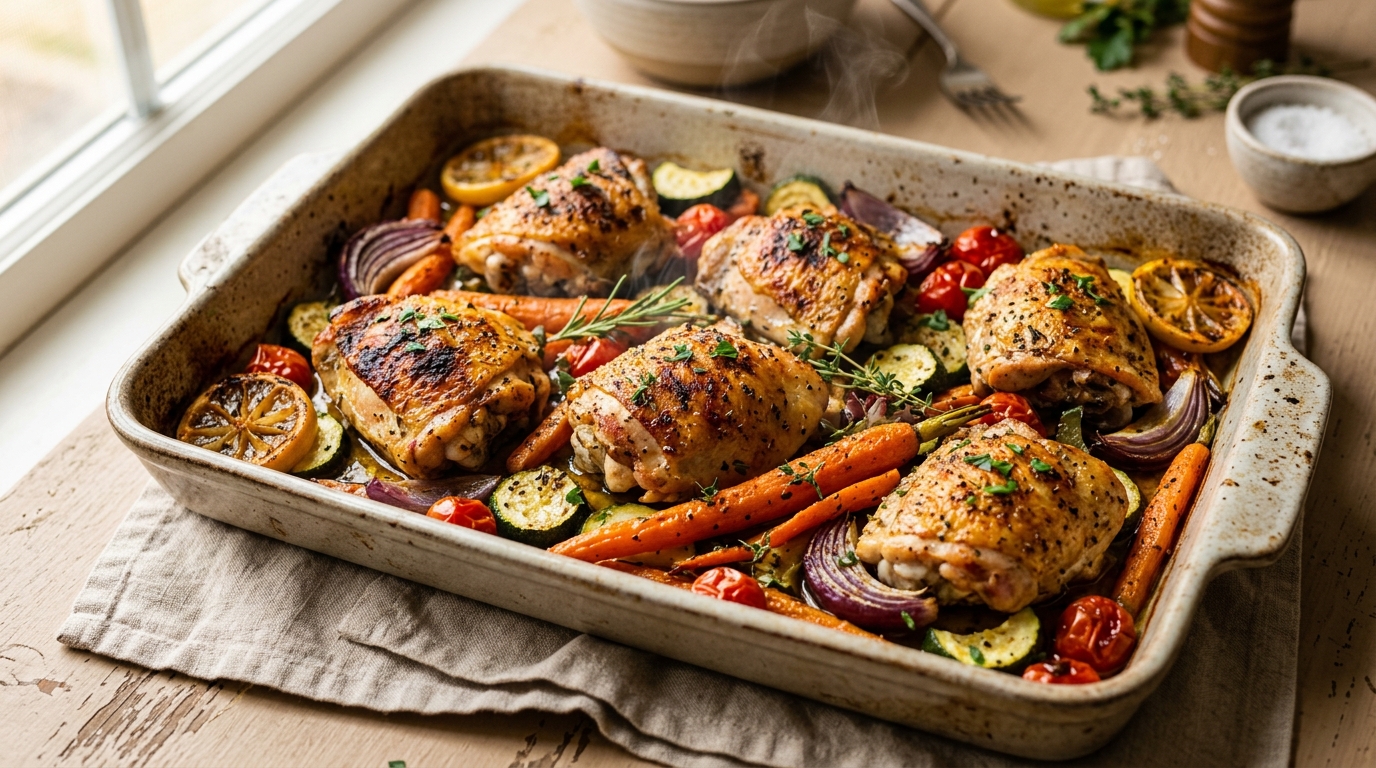
Wednesday through Friday, the fast recipes close the week: Shakshuka, which is genuinely 25 minutes from cutting board to table and forgives a tired cook; Easy One-Pan Chicken and Vegetables, which needs one pan and no babysitting; Chicken Fried Rice, the designated leftover-eater that turns yesterday's rice and any stray protein into dinner. Slot the leftover night wherever the week actually breaks — usually Thursday — and let it absorb reality. If the week somehow goes perfectly, the leftover night becomes a no-cook night with zero guilt.
The system only gets cheap and easy when the shopping list is engineered. The strategy is deliberate ingredient overlap: choose the week's five recipes so they share ingredients, and you buy each thing once while nothing rots in the drawer. Before finalizing the plan, list every ingredient across all five recipes and look for the overlaps — a bunch of cilantro that serves the biryani and the fried rice, one head of garlic that serves everything, yogurt that is simultaneously the biryani side and the tikka-style marinade base.
This is also where picking recipes from one or two cuisine families pays off. A week built around the Pakistani hub — biryani as the anchor, Daal Chawal as a fast night, aloo gosht-style flavors midweek — shares ginger, garlic, onions, tomatoes, cumin, coriander, and cilantro across nearly every dish. A week spanning four cuisines, by contrast, needs four separate herb purchases and three specialty jars, which is how produce drawers die. Rotate the cuisine family week to week rather than mixing within a single week.
Two practical rules keep overlap honest. First, plan the fresh-herb dishes for early in the week and the hardy-vegetable dishes for late — cilantro dies, cabbage does not. Second, shop your pantry before writing the list: half the point of keeping harissa, canned tomatoes, lentils, and rice stocked is that a week's plan only needs one real shopping trip.
Not every planned dinner should be cooked ahead, and pretending otherwise is why some meal-prep regimes feel like eating assignments. The split is simple: batch-cook the dishes that survive and improve reheating — braises, soups, curries, rice dishes, baked pastas — and fresh-cook the dishes that degrade — anything fried, anything with a live texture, eggs, anything where the appeal is contrast. Chili con carne made Sunday is better Wednesday. Shakshuka made Sunday is a sad Tuesday.
A workable rhythm: dedicate one two-hour block on the weekend to the batch work — one or two anchors plus a grain or legume base. This is where Beef Nihari, Harira Soup, lentils for Daal Chawal, or a pot of Chickpea Curry earn their keep, because the slow-cooked flavor develops without watching and the fridge fills with potential dinners rather than containers of mystery. Everything else cooks fresh in 25-35 minutes during the week, using the batch components as their backbone.
The fresh-cook slots are where the fast recipes from the system above live, and they stay fast precisely because the batch work has already stocked the backbone: fried rice uses the leftover rice, shakshuka uses the leftover harira-style tomato base thinking, the one-pan chicken shares its vegetables with Sunday's prep session. Batch handles the long cooking; fresh handles the finish. Neither role is optional — a plan of all batch food gets abandoned out of boredom, and a plan of all fresh food dies of exhaustion.
The final piece is the pool itself. A system needs a library of recipes you can trust blindly — known timing, tested yield, honest pitfalls — and that is what the Cuisinety collection is built to be: recipes tested in a real home kitchen, organized into cuisine hubs so overlap-shopping is easy. Browse by hub rather than one-off: a Moroccan week anchors on Lamb Tagine with Prunes or Moroccan Seven-Vegetable Couscous; an American week anchors on the roast chicken and one-pan dinners; a Pakistani week anchors on biryani and keema.
Practical starting point for your first planned week: Lemon Herb Roast Chicken as anchor one, Chili Con Carne as anchor two, Shakshuka and Chicken Fried Rice as the fast pair, and a designated leftover night. That is five dinners, roughly three hours of total weekend cooking, one shopping trip, and a fridge that stays calm all week.
Then iterate. Swap one recipe per week, keep what proved itself, and within a month you will have something better than any published meal plan: a personal rotation of tested recipes whose timings you know, whose leftovers you can predict, and whose flavors your household asks for. Meal planning fails on uncertainty, and tested recipes are certainty.
These recipes pair with this article — make them tonight:
Advertisement